
Face
Twit1
Tube
NLPInProgessGradientCompleteSMALL1

The Bitesize Neuro-Linguistic Programming (NLP) Dictionary

Welcome to the Bitesize NLP Dictionary for items beginning with S. In this section we recommend you take a look at Sensory Cues and Sliding Anchors to give you a taste of the best of Neuro-Linguistic Programming


S

Second Attention

Another way of describing the unconscious mind.

item1

Second Order Change

A change which takes place higher than the problem which is being worked on. For example if I were drowning in a pool I would want to learn to swim, but if the pool drained of water my problem would go away.

item2

Second Position

To experience things through someone else's eyes using their point of view. This is one of three perceptual positions, the others being Second and Third position. Sometimes also referred to as Dissociated.

item3

Secondary Gain

Where something which might initially appear to be negative is providing a benefit which you might not consciously be aware of. For example I recently broke my foot. It was a pain in the foot (literally) but it also gave me time to contemplate and to start to write that book I have always promised myself.

item4

Sensory Acuity

Having a refined ability to detect small differences in our sensory information so that we can make more useful distinctions on the world around us.

item5

Sensory Based Description

Using observable information from sight, sound and touch to describe something such that it is verifiable. For example to say someone is hurting would be an interpretation. To say they have a nail through their hand would be observable and verifiable (I bet they are hurting as well!).

item6

Sensory Cues

Through careful observation we can often see sensory cues which guide us to the kind of mental processing taking place.

item7

Sensory Modalities

Sensory Modalities is another way to describe the key representational systems of sight, hearing, touch, taste and smell. See Representational Systems.

item8

Simple Deletion

Where information has been left out of a statement "Just do it" for example leaves out what exactly we are supposed to do.

Just Do It!

Six Step Reframing

An NLP technique which allows you to shift people from one state to another using techniques which resolve inner conflicts in order to achieve a more positive outcome.

item21

Sliding Anchors

An NLP technique which allows you to increase and decrease a particular anchor by some form of physical movement between two points. It can be particularly effective when used to slide into a particular zone on stage for example.

item11

State

A description for how you feel, your capabilities and your behaviours at any given point in time. See also Present State and Future State.

item12

Stepping

Stepping is a way to change your perception of a particular experience by going up down or sideways one logical level. See also Chunking.

item13

Strategy

A sequence of thoughts and patterns of behaviour which lead to a particular outcome. We all have strategies for what we do and NLP seeks to identify effective strategies which can then be taught to others.

item14

Strategy Elicitation

A process whereby we use specific questions and behavioural techniques to identify the particular steps (some of which may be unconscious) someone uses for a particular strategy in order that we can learn from their strategy of help them to be more resourceful for a given outcome.

item15

Submodalities

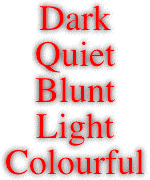
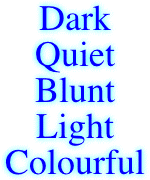
The smallest distinctions of our sensory experiences which are used when we are creating and storing our memories. These small distinctions are the key to understanding the different feeling which different memories might generate. For example if we have a visual memory it might be light or dark, colour or black and white and each of these small differences will have some form of emotional response attached.

Dark

Submodality

The smallest distinctions of our sensory experiences which are used when we are creating and storing our memories. These small distinctions are the key to understanding the different feeling which different memories might generate. For example if we have a visual memory it might be light or dark, colour or black and white and each of these small differences will have some form of emotional response attached.

Dark

Surface Structure

The words we use after we have finished processing internally. We might think "I hate that blokes tie, It's way too short" but our surface structure might be "interesting tie". Surface Structure can be consciously modified and unconsciously modified through out deletions, generalizations and distortions.

item16

Swish Pattern

A brilliant technique for switching between two different opposing experiences in order to replace a limiting resource or belief for an empowering resource or belief.

item17

Synaesthesia

The automatic linking of two senses where something senses in one system creates an automatic trigger in another system. An example is when people might describe pain as a colour.

item18

Syntactic Ambiguity

Where a sentence can have two or more meanings, for example the phrase"prostitutes appeal to pope" would be a very ambiguous headline.

Speed Freeks

Systemic Thinking

This is where problem solving is considered with the whole in mind. I like to think of it as ecological thinking where the right answer is one which is ecologically sound.

item19
NLPInProgessGradientCompleteSMALL1a1

Remember all the information in this dictionary is available in our handy iPhone and iPad App, click here to find out more

Bitesize NLP

Copyright BitesizeNLP 2012 - All Rights Reserved